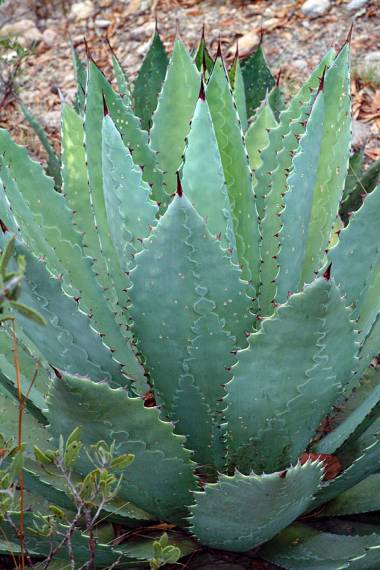
Agave mckelveyana

4. Plant Description and Characteristics

Agave mckelveyana is a perennial succulent, growing in a symmetrical rosette shape. This plant is a beautiful demonstration of resilience and natural charm.

Agave megalodonta

4. Plant Description and Characteristics

Agave megalodonta is a moderately sized, solitary agave, typically reaching about 1-1.5 meters (3-5 feet) in height and width at maturity, though the plants can sometimes grow larger. Its growth habit is generally symmetrical, forming a rounded, rosette-like structure. The most striking feature is its thick, lanceolate leaves, characterized by a grey-green hue and a glaucous bloom, appearing a bit blueish. However, the defining characteristic that gives this agave its name is the prominent, large, sharp, brown teeth (megalodonta) edging each leaf, a clear defense strategy in its native habitat. Adding to the plant’s formidable presence is a stout terminal spine at the leaf tip. Like other agaves, Agave megalodonta is monocarpic, meaning it flowers only once at the end of its life, sending up a tall, branching flowering stalk that can reach 4-6 meters (13-20 feet) bearing yellow flowers. After flowering, the plant then dies, but leaves behind seeds and often numerous offsets, ensuring its propagation. The flowers provide crucial nectar for local pollinators.

Agave mitis var. albidior

4. Plant Description and Characteristics

Agave mitis var. albidior is a relatively small to medium-sized succulent, typically forming a rosette of leaves. The most striking feature of the Small Tooth Agave is its pale, almost ethereal leaf color, setting it apart from other Agave varieties. This plant often features a color that varies between a creamy-green or grayish-green to a nearly pure creamy white, especially when young and during cooler temperatures. The plant’s manageable size and graceful form, along with its defining pale color, make it a desirable choice for smaller gardens or container growing, where it adds a touch of understated elegance. The leaves are lanceolate (lance-shaped) to slightly ovate, tapering to a sharp point. The margins (leaf edges) are typically lined with small, reddish teeth, which give the plant its common name, "Small Tooth Agave." A reddish blush often develops on the tips and margins when exposed to direct sunlight or in cooler temperatures.

Agave mitis var. mitis

4. Plant Description and Characteristics

Agave mitis var. mitis is a relatively compact beauty, thriving in both borders and containers, reaching approximately 1-2 feet (30-60 cm) in height and spreading 2-3 feet (60-90 cm). Its defining characteristic is the rosette which is its smooth, spineless, and fleshy leaves. These lanceolate leaves gracefully curve outwards. They start as a deep, rich green, and can develop reddish hues with sun exposure. Varieties with variegation also exist, enhancing their visual appeal. Unlike many of its spiky cousins, these leaves are usually smooth, a testament and unique feature of the plant itself.

Agave montana

4. Plant Description and Characteristics

The Agave montana is a visually striking succulent that forms a relatively symmetrical, often solitary rosette. Its allure stems from its bold presence and noteworthy textural features. The mature leaves are thick, fleshy, and generally broad, with an ovate to lanceloate shape, presenting an attractive, vibrant green or bluish-green hue often accented by reddish or purplish margins. These margins are typically smooth initially, but can become fibrous with age, adding further textural interest. The absence of spines along the margins, beyond the sharp terminal spine, showcases a gentler appearance compared to some of its more heavily armed counterparts. While unique markings do not typically decorate the surface, it can be found to take on hints of the surrounding minerals and substrates where it grows. Its remarkable cold hardiness, paired with its architectural form and lack of marginal spines, distinguishes it from many other agave species, making it both a robust and visually appealing species.

Agave moranii

4. Plant Description and Characteristics

Agave moranii presents an elegant form with a moderate growth habit.

  • Size and Growth Habit: Mature specimens typically reach a height and width of approximately 0.5 to 1 meter (1.6 to 3.3 feet), forming a symmetrical rosette shape. Growth is generally slow, contributing to its appeal as a long-lived ornamental plant.
  • Leaf Characteristics: The leaves are broad, fleshy, and lanceolate, characterized by a striking grey-green coloration. The leaves are rigid and slightly concave towards the center. Leaf margins are finely toothed, with small, sharp, reddish-brown spines. The terminal spine is long and strong. Young plants may feature distinct markings on the leaves.
  • Flower Characteristics: Agave moranii is monocarpic, meaning it flowers only once in its lifetime before dying, often taking many years (sometimes decades) to reach flowering maturity. The flower stalk can reach heights of up to 2-3 meters (6.5-10 feet), featuring a branched structure with many yellow blooms. The blooms’ shape are mostly bell-shaped and of a pale yellow coloring. The flowering process is an impressive display, often attracting hummingbirds and other pollinators.
  • Unique Features: The profuse production of offsets (pups) at the base of the mother plant is a distinguishing characteristic, leading to the formation of striking clumps. This clonal behavior contributes to their high value as a desirable specimen plant and ease of production.

Agave kerchovei

4. Plant Description and Characteristics

Agave kerchovei is a medium-sized succulent, generally reaching a height and width of 0.6 to 0.9 meters (2 to 3 feet) at maturity. Its growth habit is relatively slow, forming compact rosettes that can persist for many years. The leaves are its most prominent feature. They are narrowly lanceolate, gently curving upwards and outwards, with a distinctive velvety texture and a slightly grayish-green hue. The edges are typically smooth, lacking large spines, although some may exhibit small, fine teeth. These features, combined with the slow growth, make it an excellent choice for landscaping. The leaves have a charming appearance, and often feature a subtle groove along the edges, enhancing their graceful form.

Agave multifilifera

Unveiling the Wonders of Agave multifilifera: The Spider Agave

Agave plants, with their striking architectural forms and resilience, are beloved by gardeners and desert enthusiasts worldwide. Among the diverse array of species, Agave multifilifera, often called the Spider Agave, stands out due to its unique, spider-like filaments that adorn the margins of its leaves. This striking characteristic, coupled with its relative ease of care, makes it a fascinating and rewarding plant to cultivate. Did you know that while many agave species are known for their spines, particularly at the leaf tips, the Spider Agave possesses incredibly flexible, almost soft spines? Let’s delve into the fascinating world of Agave multifilifera!

Agave kerchovei ‘Huajuapan Red’

4. Plant Description and Characteristics

Agave kerchovei ‘Huajuapan Red’ distinguishes itself with an impressive and relatively compact form, presenting a captivating blend of beauty and resilience. The heart of this agave beauty lies in its foliage; specifically, the leaves, which are the plant’s defining feature. The leaves, which are typically colored a vibrant deep red or a rich purple hue, especially when exposed to ample sunlight. These lanceolate (spear-shaped) leaves are thick, succulent, and have smooth margins. The leaves have a slight curvature and often display a subtle waxy coating, providing additional drought resistance, making Agave kerchovei ‘Huajuapan Red’ a true jewel of the desert landscape.

Agave muxii

6. How to Grow Agave muxii

Agave muxii is generally a relatively easy agave to successfully cultivate, especially if you understand its needs.